
DRAINAGE
Drainage 101: Why It Matters Before Anything Else
If water doesn't move correctly, nothing else will hold up. The most overlooked piece of any landscape plan.
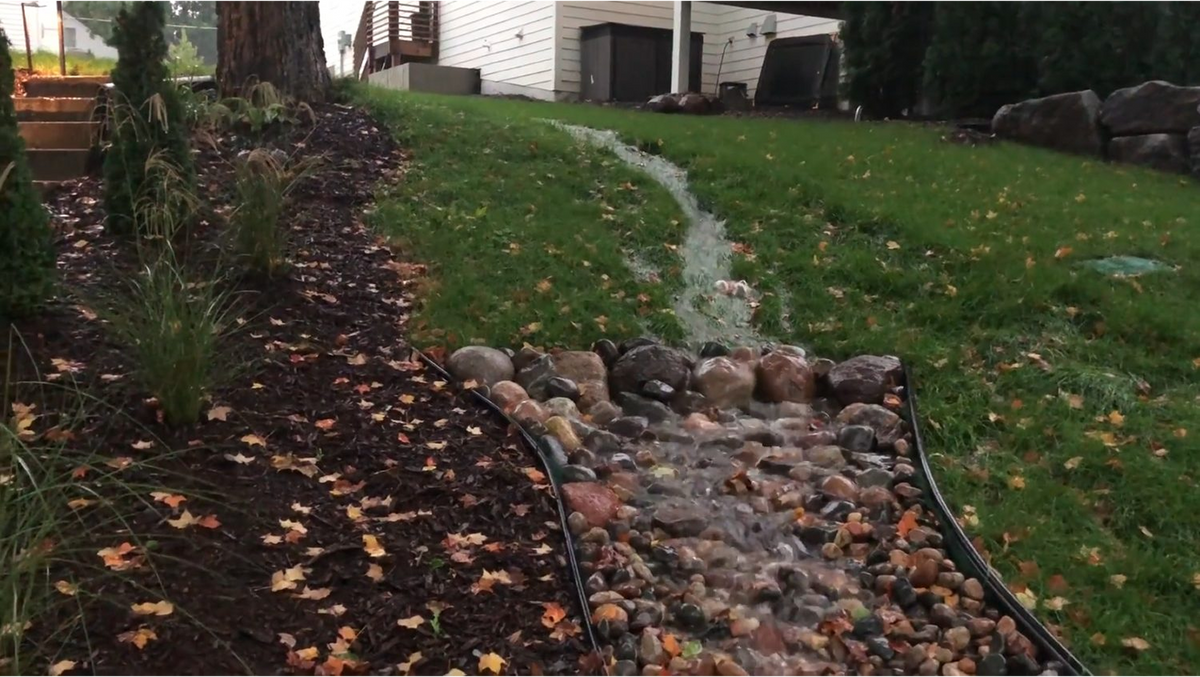
Have you ever watched water pool in the same corner of your yard after every storm and wondered whether it actually matters? It does, and it's the reason so many beautiful landscapes fail early. If water doesn't move correctly, nothing else will hold up. Not the patio, not the retaining wall, not the plantings. Drainage is the quiet decision that determines whether a landscape lasts five years or thirty.
Most homeowners think about drainage the way they think about a furnace: only when it fails. But by the time water shows itself (a heaved patio, a leaning wall, a soggy stretch of lawn that never dries out) it has usually been working against your landscape for years. The fix at that point is never a patch. It's a rebuild.
At Aspen Landscape, we've spent 46 years building across Lake Minnetonka with drainage as the starting point of every plan. If a corner of your yard never quite dries out, or you're planning a project and want the water question answered first, request a free design consultation and we'll walk the property with you. In this guide, we'll explain how water actually behaves on a property, the warning signs it leaves, and what proper drainage looks like when it's done right.
Water Always Wins (Unless You Plan for It)
Every property is a watershed in miniature. Rain and snowmelt land on your roof, your driveway, and your lawn, and then gravity takes over. Water moves downhill, follows the path of least resistance, and collects at the lowest point it can find.
The question is never whether water will move across your property. It's whether it moves where you decided, or where it decided.
In our part of Minnesota, this gets amplified by two things. First, much of the west metro sits on rolling terrain. The same slopes that give Orono and Deephaven their views also send water racing toward foundations and low corners. Second, our clay-heavy soils drain slowly. Water that would soak away in an hour in sandy ground can sit for days here, saturating the soil beneath patios, walls, and root zones.
Then winter arrives, and everything gets worse. Water trapped in soil freezes and expands, roughly 9% by volume. That expansion is strong enough to lift a patio, tilt a retaining wall, and crack concrete. Then it thaws, the ground drops, and the cycle repeats twenty or thirty times a season. This freeze-thaw cycle is the reason a beautifully laid patio can look like a rumpled bedsheet three winters later. The stone was never the problem. The water underneath it was.
The Warning Signs Most Homeowners Miss
Water is patient, and it leaves clues long before it does real damage. Here's what we look for on a first site visit, and what you can spot yourself:
- Standing water that lingers more than a day after rain. A puddle that disappears in a few hours is normal. One that's still there tomorrow afternoon means the soil below is saturated or compacted.
- A patio or walkway that's no longer flat. Heaved corners, sunken sections, and joints that opened up are freeze-thaw signatures. The base under that surface is holding water.
- A retaining wall that leans or bulges. Walls rarely fail because the blocks were weak. They fail because water built up behind them with nowhere to go, adding hundreds of pounds of pressure per square foot until something gave.
- Mulch that migrates. If you find your mulch in the lawn after every storm, water is moving across your beds with enough force to carry it. That same force is eroding your soil.
- A wet basement corner. Often the grading within ten feet of the foundation is pitched the wrong way, sometimes by as little as an inch or two. Water finds it every time.
- Grass that's greener in a stripe. A suspiciously lush line across the lawn often marks where water is channeling, or where a drain line below has failed.
None of these mean disaster tomorrow. All of them mean water is making decisions on your property that nobody signed off on.
What Proper Drainage Actually Looks Like
Good drainage is mostly invisible, which is exactly why it's undervalued. Here's what's actually happening under and around a landscape that's built to last:
- Grading comes first. Before anything else, the ground itself has to slope away from structures, then follow a deliberate path toward a place water is allowed to go. Grading is the cheapest drainage tool there is, and it's the one most often skipped, because it happens before anything photogenic gets built.
- The base under hardscape is a drainage system. A patio that lasts isn't sitting on soil. It's sitting on a deep, compacted bed of open-graded aggregate: crushed stone with the fines controlled so water passes through instead of pooling. This is the base preparation we talk about constantly, and it's the difference between a five-year patio and a thirty-year one. You can see how we approach it on our Hardscaping and Stonework page.
- Walls get drainage behind them, not just under them. Every retaining wall we build gets clean drainage rock and, where conditions call for it, perforated pipe behind the wall face, so water pressure never builds against the structure. It's buried, it's invisible, and it's the reason the wall is still plumb in year twenty.
- Water gets a destination. Downspouts, patio runoff, and slope drainage all need somewhere to end up: a dry creek bed, a buried drain line daylighting downhill, a channel drain, or an infiltration zone. A dry creek bed is drainage you can actually see. River rock and boulders form a natural-looking channel that's really an engineered spillway, quietly handling thousands of gallons per storm. Our Erosion Control and Drainage page covers the full toolkit.
- Plantings are chosen for the water they'll actually get. Species that tolerate wet feet go in low zones, and drought-tolerant plantings take the high, fast-draining ground. Fighting the water map with plant selection is a losing battle.

Why Drainage Comes Before Design
Here's the uncomfortable part: drainage work is the least glamorous line on any landscape proposal. Nobody stands at a cocktail party pointing at their compacted aggregate.
But the sequence is non-negotiable. Every element of a landscape either sits on the water plan or fights it. A patio placed in a low collection zone will heave, no matter how premium the paver. A planting bed installed across a drainage path will wash out every June. A wall built without relief behind it is a countdown clock. And a fix applied after the fact, tearing out finished work to reach the problem underneath, routinely costs more than doing it right would have.
We've torn out patios less than a year old, installed by others, because the base prep and drainage were wrong. Not one of those homeowners chose a bad paver. They chose a process that skipped the invisible steps.
This is why our design process starts with how water moves: where it lands, where it wants to go, and where we're going to send it instead. Once that's settled, the fun parts (the stone, the plantings, the fire pit) get built on ground that's going to hold them for decades.
What a Drainage Assessment Involves
If you're planning a project, or just suspicious about a wet corner, here's what evaluating a property actually looks like: walking the property during or right after rain, when water shows its hand. Checking grades around the foundation and along any planned build zones. Looking at where downspouts discharge and where that water ends up. Reading the soil for clay content, compaction, and existing saturation. And looking uphill, because the water on your property often starts on someone else's.
From there, the solutions get matched to the actual problem: regrading, base reconstruction, buried drainage, a dry creek bed, or sometimes something as simple as extending a downspout twelve feet. Not every property needs an engineered system. Every property needs someone to have checked.
Frequently Asked Questions
How do I know if my yard has a drainage problem?
The clearest signs are standing water that lasts more than 24 hours after rain, hardscape surfaces that have heaved or settled, mulch or soil washing out of beds, a retaining wall that leans, or a basement corner that gets damp after storms. Any one of these means water is collecting or moving where it shouldn't.
Can drainage be fixed after a patio or wall is already built?
Sometimes, but it usually means opening up finished work to reach the base or the area behind the wall, which is why retrofit drainage costs significantly more than building it in from the start. If a surface is already heaving, the fix is typically a rebuild of the base, not a surface repair.
What is a dry creek bed and does it actually work?
A dry creek bed is an engineered drainage channel built to look like a natural stream bed: river rock and boulders set over a prepared base, following the path water needs to travel. Done correctly, it moves large volumes of stormwater away from structures while reading as a landscape feature rather than a utility.
Why do patios heave in Minnesota?
Freeze-thaw cycles. Water trapped in or under the patio base expands roughly 9% when it freezes, lifting the surface. When it thaws, the surface settles unevenly. Over dozens of cycles per winter, that movement breaks joints and creates the rolling, uneven surface you see on failed patios. A properly built open-graded base lets water drain through instead of being trapped.
Does every landscape project need drainage work?
Every project needs a drainage assessment: a look at grading, soil, and where water goes. Not every property needs pipe in the ground. Some need only minor regrading or a downspout extension, and others need a full system. The mistake isn't skipping drainage installation. The mistake is skipping the question.
The Takeaway
Drainage isn't a line item. It's the foundation every other decision sits on. Get the water right and the patio stays flat, the wall stays plumb, and the plantings thrive. Get it wrong and no material upgrade will save the work above it. That's why it comes first, on every project, every time.
Aspen Landscape has designed and built landscapes across Lake Minnetonka and the western Twin Cities since 1980, with drainage as the starting point of every plan. If any of the warning signs above sound familiar, request a free design consultation and we'll walk the property with you. You can also see how we build on our Erosion Control and Drainage page.
Details Matter.
Keep Reading
Related Articles
 COMING SOON
INSTALLATIONS
How to Choose the Right Retaining Wall Material
Block, natural stone, or boulder - each performs differently. Here's how to match material to site.
Planning a Landscape Project?
Schedule a free consultation and we’ll help you avoid every mistake on thislist.